
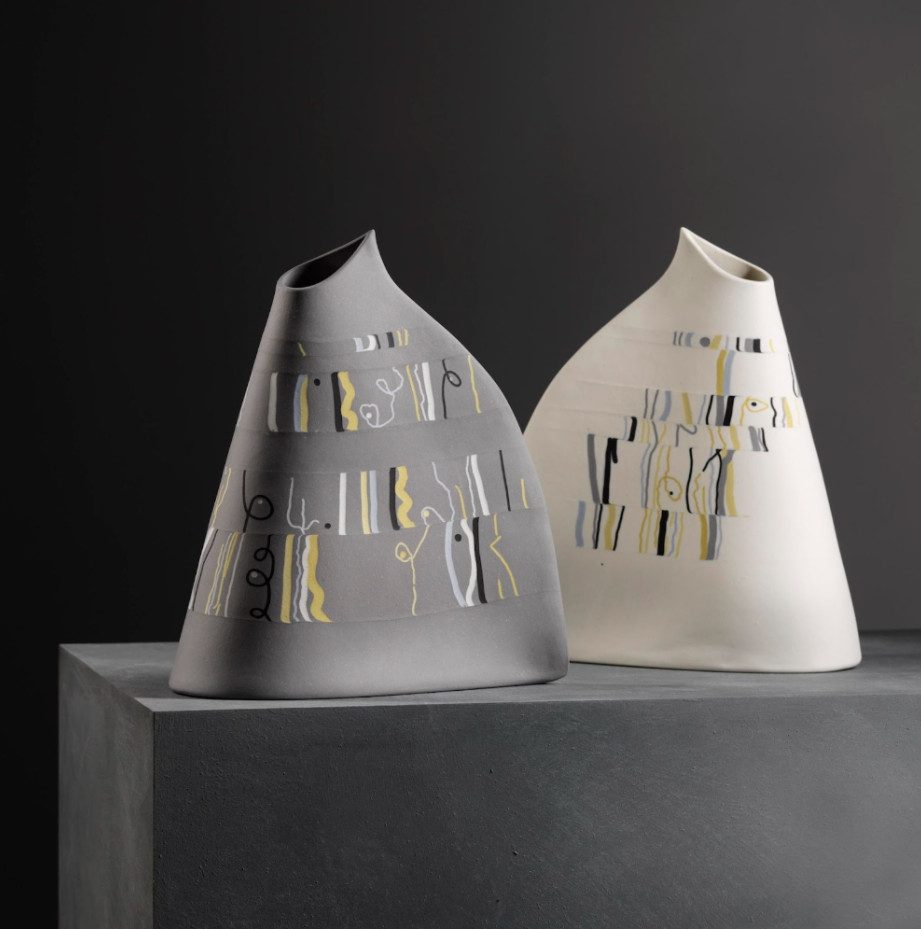
Visual Arts Scotland is delighted to share Carol Sinclair as the inaugural recipient of the VAS x Tea Green Events Maker of the Year Award.
This substantial new award is the first of its kind at VAS and marks a key moment in our evolution as a SCIO, reflecting our commitment to the dynamic grey space between artist, maker and multidisciplinary practice as our membership continues to grow and diversify.
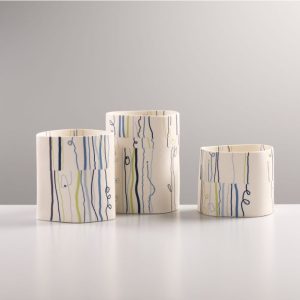
Carol is a ceramicist based in Forfar, working with clay to create one-off pieces and up-cycled material installations for exhibitions. Her finely crafted porcelain pieces explore memory, connection, surface and place, embodying the depth, sensitivity and material intelligence that define are the pillars of Scotland’s contemporary craft landscape.
The award has been developed in partnership with Tea Green Events, with selector Joanne MacFadyen. Tea Green is a leading platform supporting Scotland’s maker community and creative economy, and this partnership speaks to our shared belief in visibility, advocacy and meaningful opportunity for makers.
Here Carol gives us some insights into her practice to date, talking about her inspirations, working methods and exciting plans following this award.
Q&A
Q: Can you tell us a little about yourself and how your practice has evolved over the last few decades since graduating art school?
A: I’ve now been running my ceramics practice for 35 years and I have always really enjoyed being self employed. It means I can adapt the way I do things to suit different life circumstances, and reflecting back, there have been very distinct creative stages.
To begin I wanted to earn a living and support my family, so I ran a commercially focussed tile studio and took on staff to help me. For a while I had a gallery with my architect husband and that taught me so much about representing other makers. That in turn led to my work as a business adviser and trainer, which has brought me wonderful opportunities to work at home and abroad
Then I used my creative practice to explore the role of making in health and wellbeing. As the carer for a family member with dementia, my ceramics really helped me process what was happening, so I then worked with carers and the organisations that support them.
Now I am really focussing on developing my own creative ideas. About seven years ago I picked up a porcelain inlay technique that I had first developed at art school because it helped me work in a more sustainable and environmentally responsible way. Since then my work has used colour and pattern to explore the connections we have to one another and our environment.
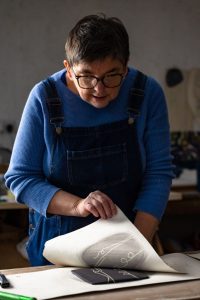
Q: There are some recurring shapes, designs and colour palettes across your work. In what ways do you take inspiration from your primary subject matters?
A: In developing my inlay technique I wanted the emphasis to be on pattern and colour, so have deliberately kept my shapes very simple. I start developing any new body of work by first creating a colour palette to capture the stories that I want to tell. I mix my own porcelain so I will take time to test combinations of colours and shades of the same colour. I reclaim all my studio waste clay to make a beautiful velvety mid tone grey porcelain that acts as a perfect backdrop to other colours. Inspiration comes from people and places, and I also have a bit of an obsession with trees and the Angus landscape. I look out from my studio to the foothills of the Cairngorms which offers me daily inspiration.
Q: What are some of the materials, techniques and processes you often use and how do they affect your work?
A: I have tried a variety of materials but always come back to porcelain because of its purity, luminosity and colour response. A while back I decided I would rather make less, but then take time to have well considered pieces imbued with meaning. In evolving my signature inlay technique I could use a minimal amount of coloured material to maximum impact. And now that I am also reclaiming the waste clay I have a range of coloured porcelain bodies that I can sandwich together that give me so many different technical and creative possibilities. It has taken a few years to develop this inlay because it is technically challenging, but I really enjoy problem solving and inventing new combinations of pattern and colour.
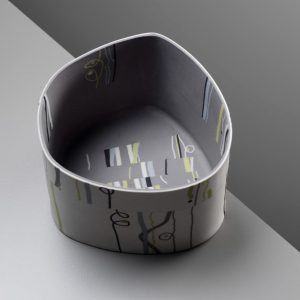
Q: There is an alluring softness and carefulness in the hand made quality of your ceramics. Could you say more about this aspect of your work and what importance it has for you?
A: I love the rigour and precision that porcelain demands, and as I evolve ever more complex combinations I am calling on all of my maths, geometry and pattern making skills. I want my work to be intriguing, perhaps even puzzling in terms of its construction techniques. I am inviting audiences to stop, slow down and consider the work in more detail so that they take time to understand more about the stories the pieces are telling. And although the final fired porcelain is polished and smooth to the touch, I balance this by creating shapes that are fluid with soft and gentle curves. For a while I experimented with other ways of working, but quickly realised that it is the hand making and material knowledge that is important in my process. I work with the clay when it is still very soft so that I can gently coax it into soft lines and rounded forms. Getting the clay at just the right moment is vital, so timing is everything.
Q: Environmental responsibility seems to be an integral part of your practice. How do you balance sustainability and high quality design?
A: That’s such a good question which sits right at the heart of my practice and is a constant balancing act. Some of the most beautiful colours or finishes in ceramics rely on chemicals or processes that are not environmentally responsible. I am currently researching my own mineral footprint so that I can better understand the impact of my choices. I am trying to reduce the quantities of colourants I use and also pay much more attention to my use of water and what I put back into our water systems. And thankfully the science behind the creation of ceramic colourants is evolving rapidly which helps to encapsulate or reduce the use of harmful chemicals. And of course any changes in your ways of working take time and patience, especially to get the very best results from the most minimal quantities of ingredients.
Q: How has your work developed over the past few years? Are there any new interests and ideas you have more recently begun to explore, or are hoping to start exploring?
A: A curator and friend recently called me a quiet activist, and I adopted that immediately as I think it sums up the way my practice has evolved over the past few years. For a long time I was wrestling with how I might run a more environmentally and socially responsible practice, and after lots of trial and error, I developed my signature inlay technique, which gave originality and meaning to my pieces. I am really excited about my current projects, working with reclaimed clay and exploring my mineral footprint at a much deeper level. And in my colour experiments I am exploring a bold combination of lime green and turquoise inspired by Solar Punk – a movement that believes that we can address the environmental crisis by combining technology and nature based solutions. And I am really looking forward to collaborating with VAS and Joanne at Tea Green over the course of this year to undertake some very exciting projects and events as part of the Maker of Year award. I am so grateful for this opportunity and plan to make the very most of it.
Q: You have had a lot of success and experience in exhibiting, creating installations and working with arts organisations over the years. What are some words of wisdom to your fellow makers and artists who are seeking to strengthen their practices and presences as creative practitioners?
A: I really love what I do and I have been lucky to work on some inspiring projects and with wonderful people. But I also work really hard, and I know that if you are committed to what you do you will make it happen. As the saying goes, luck is where opportunity meets preparation. Tapping into where your passion lies really gives you energy and helps you tell your story with clarity. And it allows you to connect with like minded people and the organisations who share your interests and values. Collaboration is a great way to take you on new creative adventures and being accountable to someone else is very motivating. Do what you do with conviction, make sure you build in the joy, but also take time to plan, reflect and learn. I never stop learning and experimenting and that’s what keeps things interesting.
Socials