Zang 葬
The Funeral of the Wind: Notes from an Orkney Residency
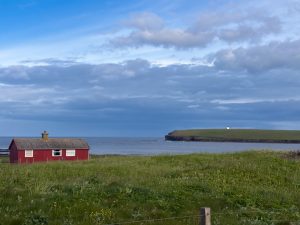
Tong and I travelled to Orkney to research and develop a sound installation centred on weather. Here, weather continually reshapes space, while also altering the ways in which our bodies perceive the world. When human-made structures recede from attention, time no longer appears to move in a straight line. Instead, it circulates through tides, shifting winds, light, and humidity. We attempted to listen to nature anew.
I
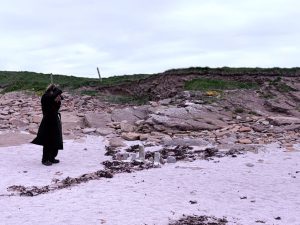
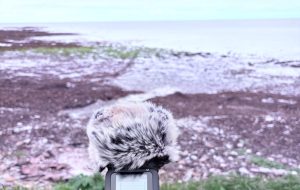
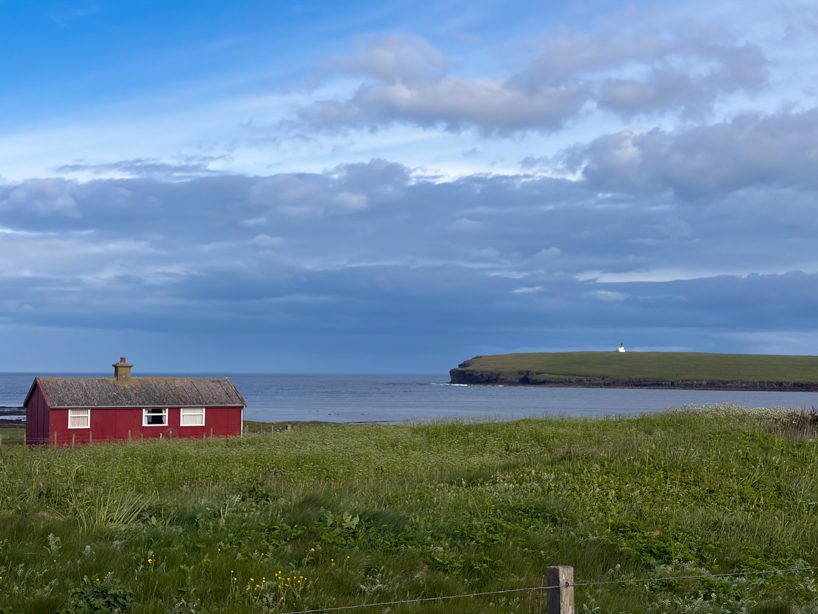
Each day, we waited along the Orkney coastline for the wind to change direction. We recorded the tones produced as it passed through the rocks and the rhythms of waves striking the cliffs. Every sound shaped by the weather and the surrounding environment became part of our research and artistic process.
Pauline Oliveros once wrote, “Deep Listening is a lifelong practice.” It is not simply a method of collecting material, but a way of learning to relinquish control. Much of the time, we did nothing but stop and wait: waiting for the waves, and waiting for our bodies to gradually adjust to the island’s particular scale of time.
II
During a visit to the Orkney Museum, we encountered archaeological material concerning the islands’ prehistoric sites, as well as local folklore surrounding the Trow and the remains of ancient brochs—circular stone towers found throughout northern Scotland.
For centuries, the original builders and purposes of these ancient towers and mounds were not fully understood. They were therefore often imagined as dwelling places of the Trow: subterranean beings said to emerge only at dusk or during the night, moving with the wind. These stories gave form to local attempts to understand the landscape and the unknown forces inhabiting it.
Later that afternoon, when we returned to the coast to make recordings, we met a local shepherd. We spoke to him about the stories of the Trow. He laughed and said: “The weather on the islands changes so quickly. Sometimes, people going out to sea would rather believe that something invisible really does live in the wind. These places have always been here—longer than any of us.”
We began to understand that mythology continues to exist within the lived experience of the island’s residents and in their relationship with the landscape.
These readings and conversations led us, on returning to the coast, to imagine Zang 葬 as a form of funeral ritual: an attempt to narrate presences suspended between mythology, weather, and the environment. We imagined a group of beings whose rhythms followed dawn and dusk, moving between wind and waves. The work became an attempt to perceive the fleeting moments in which such beings might become present.
III
The final form of the work was not determined by us, but by the interaction between Orkney’s landscape and its weather.
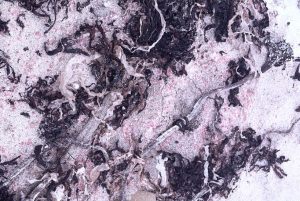
We became drawn to the large quantities of seaweed washed ashore and dried by the wind. Some had been bleached by seawater, while other pieces retained their dark brown fibres. Others had become soft and translucent after remaining submerged in salt water for long periods.
We attempted to arrange, weave, and secure the seaweed, but discovered that once it was removed from the sea, it quickly curled and contracted beneath the sun and wind. A sudden spell of light rain, however, would cause it to unfold again, returning to something close to its original form. The material continued to follow its own rhythm.
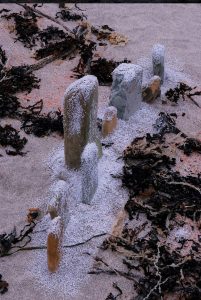
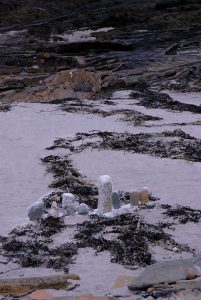
Along the shoreline, we also found large numbers of rocks saturated with seawater. Some were already covered with a fine layer of white salt, while others retained a damp sheen. We began documenting the gradual formation of salt crystals.
Sometimes an entire night would pass without any visible change. At other times, after exposure to wind and sunlight, tiny crystals would quietly begin to grow along the cracks in the stone.
These formations were determined collectively by wind, humidity, sunlight, and seawater. Every small crystal and every line in its structure preserved a trace of the interaction between wind direction, salinity, and moisture. Our role was simply to observe patiently and bear witness to these changes.
We attempted to respond to the site rather than impose a predetermined form upon it. Seaweed, stone, salt, and sound were not materials waiting to be shaped. Each possessed its own way of generating form.
Our task was only to create the conditions for a beginning, and then wait for the wind, the sea, and time to complete what remained. In Orkney, the participation of the weather made this artistic practice possible.
IV
The same relationship emerged through sound.
The wind repeatedly disrupted our recording plans. Low frequencies shifted according to the movement of the waves and the formations of the land. Sounds we had prepared in advance were often covered by distant birdsong.
Yet the sounds we initially understood as interference gradually became inseparable from the work itself.
Within Zang 葬, “The Broch Trow” is therefore not a character that needs to be seen. It is instead a presence continually produced by the weather: a body that remains perpetually in the process of becoming.
It exists in the momentary echo created when sea wind passes through the ruins. The sea salt leaves traces of its presence. It also exists within the few minutes of silence that emerge when people stop and listen.
V
At the end of the residency, we presented an open-ended, site-responsive sharing of the work.
Visitors could arrive at the coast at any time. Whenever someone was willing to stop, to wait with the wind and breathe with the sea, the work was already taking place.
We came to realise that what had truly changed was the perceived boundary of the site itself.
VI
After leaving Orkney, I continued to think about the islands: the weather changing each day, the slow growth of salt crystals, and the unrestricted movement of the wind that no recording device could ever fully capture.
The significance of this residency lay in how it reshaped our understanding of artistic research.
The aim was not to explain nature, but to search within nature for a way of experiencing existence.
Perhaps what Zang 葬 truly buries is not a mythological spirit of the weather, but our own attachment to control, certainty, and completion.
The wind left no answer.
It simply carried every question back into the sea.
We are grateful to Linkshouse – Orkney Arts Residency, the connection with the Pier Arts Centre, Visual Arts Scotland, and the local landscapes and conversations that supported this research. Orkney offered us not only a site, but a way of listening—to weather, memory, and the fragile presences between land and sea.
Exhibition Information
Title: Zang 葬: The Funeral of the Broch Trow
Artists: Tong Niu and Tingqi Liu
Medium: Sound installation, field recordings, seaweed, seawater, salt crystallisation, stone, and low-frequency vibrations
Location: Orkney, Scotland
Date: June 2026
Websites: synaniutong.com / tingqi.net
Instagram: @tongniu_ / @tingqinet