
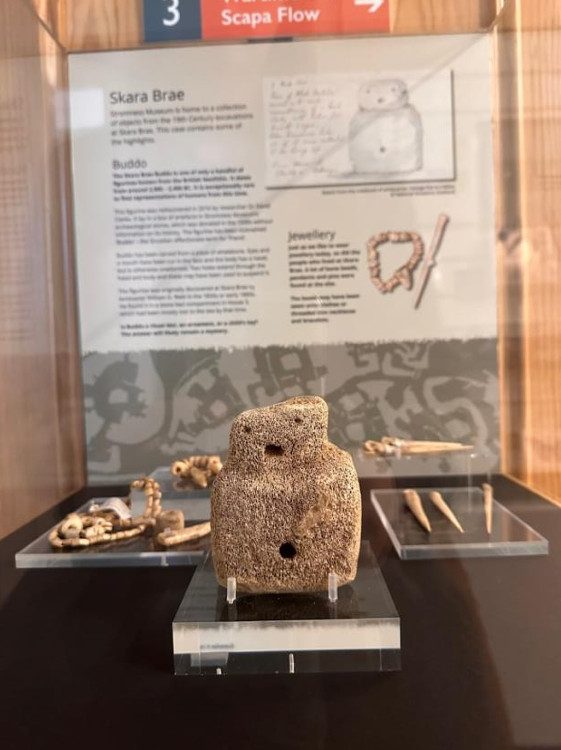
Oli Turner is a visual artist from Yorkshire, currently based in Glasgow. Her practice is multidisciplinary, rooted in the exploration of landscape, place and memory. Her work is shaped by journeys into remote and rural environments, investigating themes of ecology, decay and the interrelationship between inner and outer worlds. Using a contemplative visual language, she reflects on the evolving bond between humans and the natural world, creating work that invites slow looking and reflection. Recent projects have focused on the ritual landscapes of the British Isles, particularly Neolithic sites in Scotland, where layers of human history lie embedded in the earth. For Oli, these ancient places act as portals to explore continuity between past and present, revealing how memory and meaning can be held within the land itself. At the heart of her practice is a search for solace in nature – a counterpoint to the disconnection and noise of contemporary life.
Post 1
Hello, I’m Oli Turner, and over the next few days I’ll be sharing reflections from a month spent in Orkney through the Visual Arts Scotland residency at the Pier Arts Centre. People often say that Orkney is a magnet; once you’ve visited, it draws you back. I first came here a few years ago on a brief camping trip. Although I only stayed for a few days, the experience had a lasting impact on me and my work. Since then, Orkney’s landscapes, archaeology and coastlines have continued to shape my thinking. This residency gave me the opportunity to return and spend a month based in Birsay, where the North Sea meets the Atlantic. Much of my time was spent walking, observing, reading, gathering materials, visiting cairns, tombs and exploring some of the outer islands. The presence of stone in Orkney is vast. Everywhere you look there are traces of deep geological time, human history and ritual activity layered into the landscape. Orkney feels like a place where past and present remain in constant conversation. Over the next few days, I’ll be sharing some of the experiences, encounters and places that informed my time on the islands.
Post 2
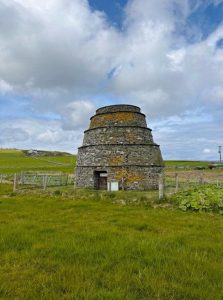
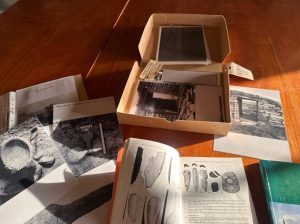
Alongside walking and exploring, much of my time in Orkney was spent researching. I often think of research as another form of wandering. Rather than moving through a landscape, you move through layers of stories, objects and histories. I spent time visiting archives and museums across the mainland and the outer islands, as well as speaking with archaeologists, artists and islanders. During my residency I became increasingly interested in how materials such as stone, bone and flint have been used by communities over time. The traces of these materials remain highly visible in the Orcadian landscape and form an integral part of my work. One morning I spent time with archaeologist Mark Edmonds, who taught me flint knapping techniques. I also visited the archives of UHI Archaeology to examine Mesolithic microliths excavated from Linkshouse in Stronsay. At Stromness Museum herbarium I looked at plant specimens from the 19th and 20th centuries and researched herbs that may once have been used within Neolithic houses and ritual spaces, including henbane, mugwort, and meadowsweet. I was also researching the uses of whale bone. The archives at Kirkwall Library contained photographs of whale bone artefacts, while a whale and dolphin conservation meeting run by WDC helped inform my understanding of these species and their anatomy. I visited Lynne, a storyteller, where conversations drifted between history, myth and local memory. The archives on the outer islands, including North Ronaldsay, Hoy, and the Kelp Store on Papa Westray also fed into my research. I often enjoyed exploring the archives first before heading out on foot to seek out the landscapes connected to what I had encountered. What interested me most was how these different forms of knowledge overlapped. Archaeology, ecology, folklore and lived experience never felt entirely separate. Over time I settled into a rhythm between researching, writing and drawing, walking and making photographs. Some of the most important moments of the residency came from allowing connections to emerge between these different ways of understanding a place.
Post 3
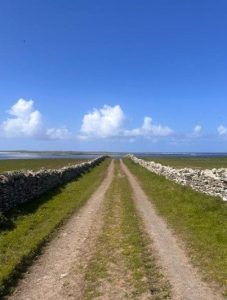
Walking has become one of the central methods within my practice. Often, I would leave early in the morning and not return until evening. Some days I walked for eight or nine hours following cliffs, sheep tracks, beaches, and old paths. For me, walking is a way of slowing down enough for the landscape to truly enter the body and imagination. At first glance Orkney can appear sparse, but the longer you spend moving through it, the more it begins to reveal itself. Small shifts in geology, changing bird behaviour, and fragments of archaeology emerge from the landscape. Everywhere felt layered with traces of the past. Walking also creates a space for thought. I often stopped to sketch, make photographs, and spent time sitting alone inside cairns, listening to the silence. Many of the questions that shape my work emerged during these long solitary journeys. Although I was based in Birsay, much of the residency unfolded through journeys to Rousay, Hoy, Papa Westray, and North Ronaldsay. On these islands, particularly North Ronaldsay where I camped for several days, the weather was raw and unforgiving. The coastline is scattered with the remains of whales, dolphins, seals and sheep, slowly returning to the landscape. Walking amongst these traces of life and decay felt like moving through both recent and ancient histories at once. It was here that I had a strange encounter with a fulmar, whose red oily stomach contents splattered onto a rock beside me before it laid an egg, stared at me for a moment, then flew off as if nothing unusual had happened. Some of my most memorable experiences came through conversations. Tea shared with islanders. Stories exchanged with fishermen, artists, weavers and former lighthouse keepers. Again and again I was struck by the generosity of people willing to share their knowledge, memories and the occasional lift back to my campsite after a long day’s walk.
Post 4
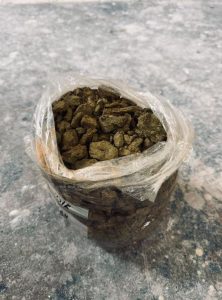
I have always been drawn to materials that carry evidence of time — things shaped slowly through erosion, weathering, decay and transformation. They remind us that landscapes are never fixed but constantly evolving. Throughout the residency I filled my pockets with small fragments found during walks: weathered bones, smooth stones, feathers, driftwood and other traces left behind by the landscape. For me, access to remote landscapes scattered with objects such as these is integral to both my photographic and sculptural work. Whereas in Glasgow I often travel significant distances to find them, in Orkney they formed part of my everyday surroundings. I began gathering materials to work with too. Generous local potters, including the Harray Potter, helped me identify local clay and shared techniques for working with it. I also spent time searching for flint. Although flint does not occur as natural bedrock in Orkney, it was transported there at the end of the last Ice Age and can still be found on some of the beaches around Deerness. A stone can contain an entire afternoon. A bone can return me to a particular stretch of coastline, a conversation, a quality of light, or a feeling that would otherwise be difficult to describe. A collection of objects becomes a map of experiences, a material archive of places I have visited. The objects grant me access to these memories after I have returned home.
Post 5
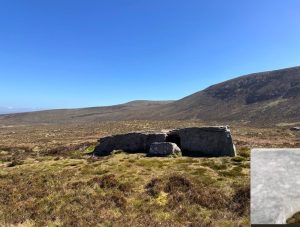
For my final post of the Instagram takeover, I wanted to write about what felt like the closing chapter of my residency in Orkney. Spending the night in the Dwarfie Stane remains one of the most memorable moments from my time on the islands. The Dwarfie Stane is a Neolithic tomb carved into a block of red sandstone on the island of Hoy. The stone itself is also a glacial erratic, adding another layer to its history. Tool marks are still visible on its roof, where it was carved using antler and stone around 5,000 years ago. The tomb is an intensely resonant space. By singing specific resonant frequencies, it is possible to produce powerful acoustic vibrations within the chamber. My companion Jemima and I spent a while searching for this note, which became unmistakable once we found it. Certain notes seem to vibrate through the stone and travel through the body, transforming the tomb into something almost instrument-like. Spending a night within a Neolithic monument felt important to me – it offered a different way of experiencing these ancient spaces and felt like a gesture of gratitude to Orkney itself. The final slides show a maquette inspired by the visit. I plan to develop this into a much larger sculpture for an upcoming exhibition. As my residency came to an end, I left with a notebook full of observations, drawings, pockets full of gathered objects, rolls of film ready to be developed, and sculptures ready to be made. The month was beyond fulfilling – the generosity, knowledge and time shared by people across the islands continually amazed me. The landscape itself has inspired new lines of enquiry and a body of work that I am now developing back in Glasgow. Thank you to Visual Arts Scotland, the Pier Arts Centre, the residency team, and everyone I met along the way for making this possible. You can follow my work @_oliturner to see future exhibitions and projects that emerge from my time in Orkney. – Fourth image taken by @jemima.e.hall
Full Instagram Takeover – https://drive.google.com/file/d/15fK8W3AmAxuIBEJ4GOBLVOBNk8_y9cKw/view?usp=sharing